When Liam was in upper primary, he had one close friend named Mark. They had been desk mates for three years and spent break times playing football and chasing each other in tag. Their friendship stayed strong until junior secondary, when Mark joined a popular group. As a teenager, Liam wanted to make new friends to hang out with and talk about things he couldn’t share with his parents, like his crush on a girl in his class.
Wanting to help, Liam’s dad encouraged him to join activities he enjoyed, explaining that it would be easier to connect with peers who shared his interests. Liam took the advice and joined the school football team, but after a whole year of practices, matches, and training sessions, Liam still hadn’t made a single friend. All of this left him feeling frustrated and wondering what he was doing wrong. To understand why the advice didn’t help, we need to look at the thinking patterns and behaviours of socially anxious teens.
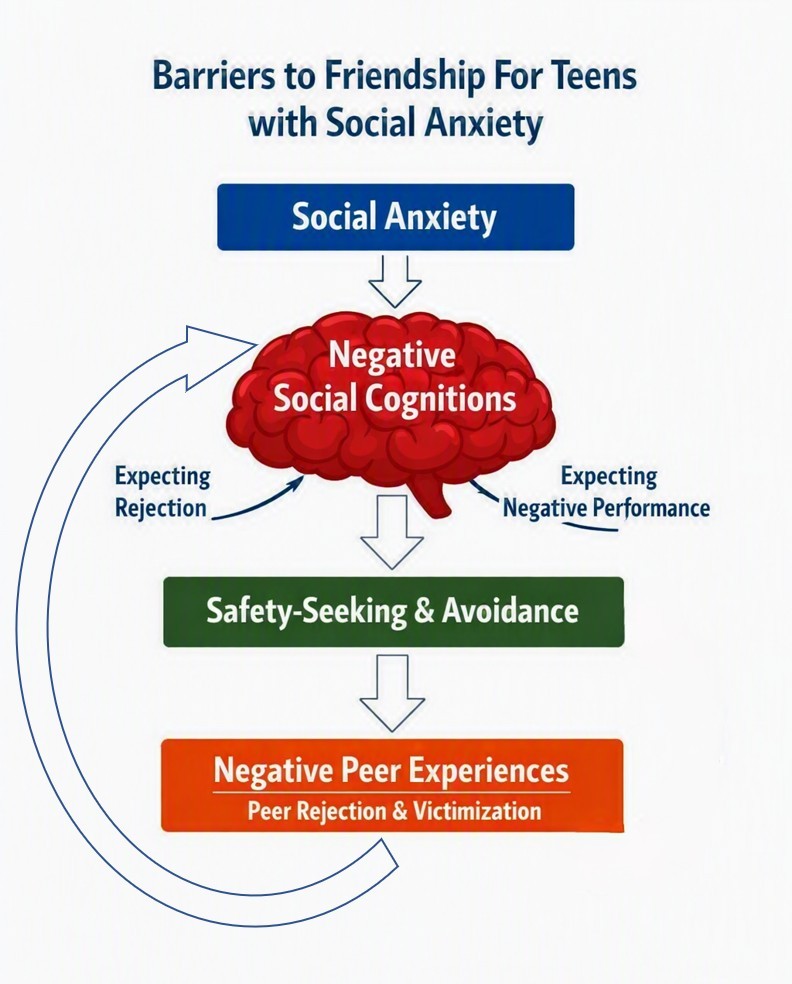
Expecting rejection: One Friday afternoon, Liam walked toward the football pitch where six teammates were in a loose circle talking. He wanted to join them, but as he got closer, he thought, “They will not like me.” Later at recess, he tried to join another group of boys, but they stopped talking when he came over. Liam saw this as proof that “They find me boring and uninteresting.”
During adolescence, teens begin to think in more complex ways. They start comparing themselves to their peers and become more aware that others are also judging them. 1 This awareness leads to growing concerns about how classmates and teammates might view them. They become highly sensitive to the fear of being judged negatively. This fear is a key feature of social anxiety, which primes them to expect rejection in everyday interactions.2
That’s why Liam’s first thought when approaching the group was that they would not like him. Later, when the boys stopped talking as he joined them, he interpreted their behavior as rejection and was convinced that they found him uninteresting. His expectation of rejection shaped how he saw the situation, even though the evidence wasn’t clear.
Expecting negative performance: During one of the practice sessions, the coach asked the players to split into smaller groups to discuss strategies for an upcoming match. To make it fair, two teammates, Adrian and Byron, were chosen to call out names for their groups. Liam was picked into Adrian’s team, and together they moved toward their meeting point. As the group began brainstorming, the first thought that came to Liam’s mind was, “I won’t know what to say.”
At one point, Adrian noticed Liam had been quiet and asked him what he thought about an idea another teammate had suggested. Liam started rehearsing possible responses. After a long pause, he gave a brief response in a soft tone while avoiding eye contact with Adrian or any other member of the group. As he spoke, his voice was shaky, his heart was pounding, and sweat gathered on his forehead. He also worried that the nervousness was visible to everyone. The next time the team was asked to form groups, Liam’s name was called out last. He felt so embarrassed and inadequate.
Liam actually had more ability than he realized. But when he expected to perform poorly, those negative thoughts got in the way of using the social skills he already had. Joining and maintaining a conversation depends on skills like keeping eye contact, showing interest with facial expressions and tone of voice, responding quickly, giving fuller answers, and asking follow‑up questions.3 4 These skills work best when someone stays focused on the people they’re talking to and shows genuine interest.
For Liam, though, the expectation that he would fail made him focus on his own feelings. Instead of listening closely, he noticed his racing heartbeat, the heat in his face, and the worry that others could see his nervousness. This made it harder to respond naturally. He paused too long, gave short answers, and came across as less expressive. As a result, the conversation felt awkward, and it discouraged his teammates from responding positively or including him in their conversations.
Safety-seeking behaviours: Besides drawing his attention inward, negative thought patterns often push socially anxious teens to rely on safety‑seeking behaviors, which can unintentionally affect how peers respond.5 In the previous example, Liam showed several of these behaviors. He mentally rehearsed sentences before speaking to avoid saying something wrong or sounding funny. He avoided eye contact to reduce the fear of being scrutinized and minimized body movement to conceal the physical signs of nervousness. The problem is that peers can interpret these behaviors as a lack of interest in the conversation. As a result, they may respond less positively, leaving the socially anxious teen feeling even more left out.
Avoidance and withdrawal: With time, Liam began to avoid group activities and casual conversations with his teammates. He would show up, play his part during practice, and then leave immediately while the others stayed behind, chatting and laughing together. By keeping his distance, Liam’s teammates thought that he was aloof and a snob, which discouraged them from including him in their conversations.
In addition, the avoidance meant Liam missed the chance to strengthen important social abilities, like giving elaborated responses, using facial expressions, showing open posture, cooperating in group tasks, and expressing his ideas assertively. Without these abilities, his later interactions felt increasingly awkward, and peers were less likely to respond warmly.
Avoidance and withdrawal hinder the development of age‑appropriate social skills. Peer interactions are the natural setting where adolescents practice and refine social and conversational skills like facial expressions, cooperation, and assertion. When socially anxious teens avoid joining activities or engaging with peers, they miss these opportunities. As a result, when they do interact, they might appear awkward or disconnected, which makes peers less likely to respond positively.
Peer victimization: Liam’s tendency to keep to himself gradually made him stand out within the football team. Some boys began teasing him, calling him “the quiet one” and joking that he never talked. On the field, a few teammates started pushing him harder during tackles or passing the ball roughly, disguising it as part of the game but clearly targeting him.
Safety‑seeking behaviors, most notably spending time alone, can mark socially anxious teens as “easy targets.” As a result, they are more likely to be singled out for teasing, exclusion, or other forms of victimization.6 In Liam’s case, his quietness and withdrawal made him vulnerable to being teased, excluded, and treated roughly on the field.
Feedback loop: Over time, Liam internalized the negative experiences of being disliked, excluded from peer activities, and being singled out for teasing or rough treatment on the field. Each incident reinforced his belief that social situations were threatening and that he could not cope effectively.7
These reinforced beliefs increased his reliance on safety-seeking behaviours. While these strategies gave him short-term relief, they limited his opportunities to practise and refine social skills. As a result, his interactions often felt awkward, which increased the likelihood of further negative outcomes with peers. This creates a self- perpetuating cycle: social anxiety > negative cognitions > safety-seeking behaviour and avoidance > skill underdevelopment > negative peer outcomes > reinforced negative cognitions, looping back to negative cognitions and increased difficulties in making friends.
Further Reading
- Parker, J. G., et al. (2006). Peer relationships, child development, and adjustment: A developmental psychopathology perspective. In D. Cicchetti & D. J. Cohen (Eds.), Developmental psychopathology: Vol. 1: Theory and Methods (2nd ed., pp. 96–161). New York: Wiley. ↩︎
- Clark, D. M., & Wells, A. (1995). A cognitive model of social phobia. In R. G. Heimberg, M. R. Liebowitz, D. A. Hope & F. R. Schneier (Eds.), Social phobia: Diagnosis, assessment, and treatment (pp. 69–93). New York: Guilford. ↩︎
- Erath, S. A., et al. (2007). Social anxiety and peer relations in early adolescence: Behavioral and cognitive factors. Journal of Abnormal Child Psychology, 35(3), 405–416. https://doi.org/10.1007/s10802-007-9099-2 ↩︎
- Greco, L. A., & Morris, T. L. (2005). Factors influencing the link between social anxiety and peer acceptance: Contributions of social skills and close friendships during middle childhood. Behavior Therapy, 36(2), 197–205. https://doi.org/10.1016/S0005-7894(05)80064-7 ↩︎
- Rapee, R. M., & Heimberg, R. G. (1997). A cognitive-behavioral model of anxiety in social phobia. Behaviour Research and Therapy, 35(8), 741–756. https://doi.org/10.1016/S0005-7967(97)00022-3 ↩︎
- Tillfors, M., et al. (2012). Prospective links between social anxiety and adolescent peer relations. Journal of Adolescence, 35(5), 1255–1263. https://doi.org/10.1016/j.adolescence.2012.04.007 ↩︎
- Miers, A. C., et al. (2011). Negative social cognitions in socially anxious youth: Distorted reality or a kernel of truth? Journal of Child and Family Studies, 20(2), 214–223. https://doi.org/10.1007/s10826-010-9390-2 ↩︎


Leave a comment