
Ann, my elder sister, was a natural. She commanded stages with her deep alto voice and won flute competitions at the national level. “You should consider music, Nia,” She had told me once. “Learning an instrument sharpens your mind and helps with focus and concentration. It’ll do you good.” I wasn’t sure I had the talent, but my sister believed in me, and that was enough.
Convinced, I signed up for music class. Ms. Karanja, the music teacher, was warm, lively, and believed every student had the potential. Soon after the basics, she introduced the flute. I was super excited and curious. I practiced wherever I could in the school field after classes, in the dorm, and at home with Ann’s guidance until I learned to control my breath and play clear notes.
Back in the classroom, Ms. Karanja called students one by one to the front to play simple melodies. I watched in silence as my peers played their flutes away. Then the teacher called out, “Nia, your turn.”
Immediately, a wave of heat radiated from the pit of my stomach. My heart raced, and I worried that my peers could hear it pounding through my chest. My forehead and palms dampened, making the flute slippery beneath the grip. Meanwhile, my throat tightened, and my fingers, which had been steady just over an hour ago, were now trembling.
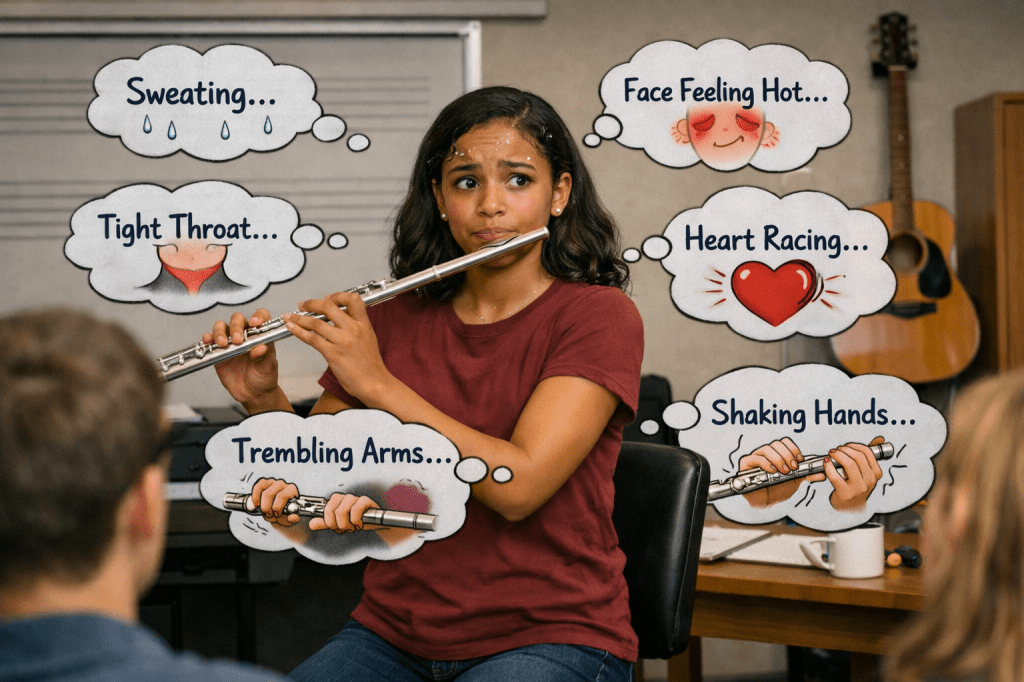
I forced myself to play, but the melody was all over the place. In that moment, I felt embarrassed and humiliated because of all the wasted effort. Ms. Karanja was patient. “Try again,” she encouraged. But the panic was already sinking in the knowledge that I was failing. “I think I need more practice first,” I whispered. She hesitated, then nodded.
I stopped attending music classes soon after because I could not stomach the pain. I consoled myself that maybe music wasn’t meant for me after all. What I didn’t realize was that this intense anxiety would prevent me from participating in other activities as well.
For weeks, I watched from the bench as Jane glided across the tennis court with effortless swings and swift movements. Just as skilled was Shamim, who ruled the badminton court. I imagined myself on the court gripping a racket and feeling the weight of a game in motion. I wanted to play, and all I needed was to ask.
I had rehearsed the words every day. “Hey, Jane, I’ve been thinking about playing tennis. Could you help me get started?” “Shamim, I want to learn badminton. What do I need?” I even thought about speaking to Coach Kamau. Maybe if I asked him first, I wouldn’t feel the pressure of approaching Jane and Shamim directly.
I said the words in my mind, over and over. “Excuse me, Coach, I’ve been thinking of playing badminton.” “Sir, how does one enroll for training?” They sounded right in her thoughts.
I vividly remember one occasion when I saw him walking across the courts just before practice, stopping to speak to a small group of students. I knew this was my chance, but immediately, I felt the now-familiar panic. My heart rate increased rapidly, and my breathing shortened. I couldn’t do it. Several other perfect opportunities came and went. Soon, the term ended.
The following term was drama festival season, and the common room buzzed with excitement, laughter, nervous murmurs, and bold declarations from girls who were eager to show off their acting skills. It was audition day for the inter-house drama competition, and my house was searching for fresh talent among the new students. The scene we were supposed to audition for was an expectant mother in excruciating pain at a bus stop. Some of the older girls giggled at the absurdity of the prompt, while others eagerly stepped forward with their faces contorted into expressions of agony and wailing in distress.
I tucked myself behind the group, careful not to stand where I could be seen. I could not imagine acting out such a scene in an empty room, let alone in front of a crowd. The very thought of all those eyes watching and judging made my stomach turn.
Then the older students began scanning the room and calling names.“Nia?” I pretended not to hear.
“Nia, come on!” Emily nudged me forward, but I shook my head quickly, eyes glued to the floor, hoping and praying they would move on.
“She’s shy,” someone whispered, half amused.
“Just give it a try,” another voice chimed in.
The moment stretched long enough that the older girls turned to someone else.
I continued with the same pattern in class presentations, debate auditions, and club sign-ups. I was always dodging, disappearing, and watching from the sidelines while others stepped into the very moments I feared.
Avoidance, over-rehearsing conversations, and avoiding eye contact were safe escapes from uncomfortable performance situations. And for a while, these strategies seemed to work. However, social anxiety isn’t something you escape. It grows beyond classrooms and courts into new spaces, shaping choices, silencing voices, and stealing lifetime opportunities and experiences.
In Chapter 5, I explore how avoidance continued to feed my anxious thoughts.
 Social Anxiety Unmasked
Leave a comment