
A Content Analysis of YouTube Comments about Coping with SAD

Technology
NVivo
Project Duration
2 weeks
Role
Qualitative Data Analyst
Coping strategies are a critical factor in the outcomes of social anxiety disorder (SAD). In the transactional model of stress and coping, Lazarus and Folkman showed that individuals cope with stressful events through problem- and emotional-focused strategies. Literature has demonstrated that emotion-focused coping strategies maintain or worsen anxiety. Despite this awareness, there’s a lack of empirical research on the coping strategies used by people with SAD in the Kenyan context. A few people have used social media to raise awareness. On 24 September 2021, a lifestyle content creator conducted an interview to describe the experiences of an individual with SAD. At the time of this study, 263 comments had been made. Thus, the researcher in this study wanted to explore coping strategies in a sample of people with self-reported social anxiety by analyzing the YouTube comments.
All the 263 comments were captured using N-Capture and the dataset was imported into NVivo. 3 comments were not related to SAD and were excluded. 49 replies on comments were also excluded as this would involve a qualitative analysis of the interactions between commenters, which was beyond the scope of this study. Of the 211 comments included, 38 commenters had self-reported SAD.
The QDH analyst developed a coding scheme based on the transactional model of stress and coping. The two key categories were emotion- and problem-focused strategies. Emotion-focused strategies could fall into different sub-categories e.g. avoidance, seeking emotional support, acceptance and turning to religion. Problem-focused strategies were further subcategorized into active coping and seeking instrumental social support. (see Figure 1)
Figure 1: Coding Scheme

The analyst then reviewed all comments carefully highlighting all text that appeared to describe a coping strategy. All highlighted text was coded using the predetermined categories and subcategories. Text that could not be coded into any of the categories was assigned a new label. After the initial coding, the analyst examined the data for each category. Active coping was split into treatment (therapy and medication) and initiating social interactions. An additional category ‘I don’t know’ was added. (see Figure 2)
Figure 2: Refined Coding Scheme
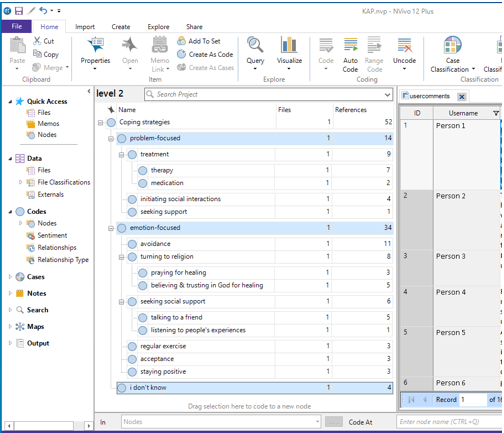
Consistent with previous research, the commenters with self-reported SAD relied more on emotion-focused strategies and a few did not know how to cope with the condition. Emotion-focused strategies reported by the commenters were avoidance, turning to religion, seeking emotional support, acceptance, focusing on positives and exercising. Problem-focused strategies used by the commenters were treatment (different forms of therapy and medication), making an effort to interact, and seeking social support.
 Social Anxiety Unmasked