
Have you ever wondered where the line between introversion and social anxiety disorder lies? Let’s explore the key differences and similarities that blur this line.
Introversion vs. Social Anxiety Disorder
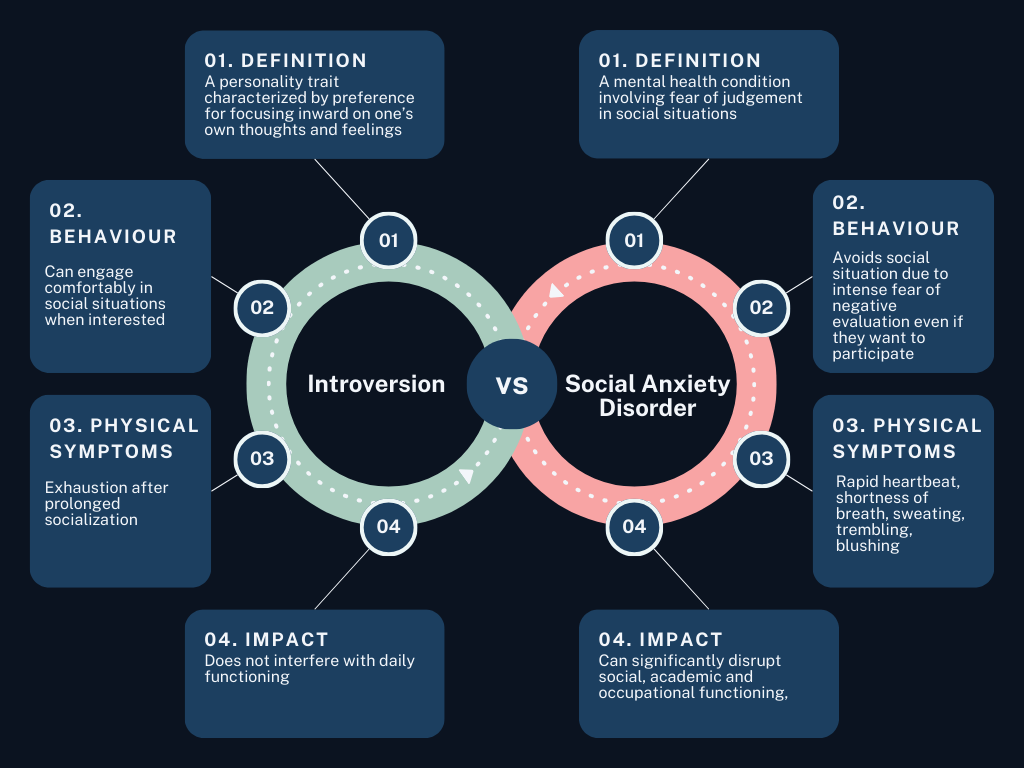
***This diagram is provided for informational purposes only and is not intended to diagnose or replace professional advice. If you or someone you know is experiencing symptoms of social anxiety or any mental health condition, please consult a qualified healthcare professional for an accurate assessment and guidance.
Overlapping Aspects
- Quiet and Reserved: Both introverts and socially anxious individuals may appear quiet or reserved in social situations. For introverts, this stems from a natural inclination toward reflection, while for those with social anxiety, it may be a coping mechanism to avoid drawing attention.
- Preference for Smaller Social Circles: Both introverts and individuals with social anxiety may prefer smaller, intimate gatherings over large crowds. Introverts prefer these smaller settings due to their desire for meaningful connections, whereas individuals with social anxiety find them less intimidating.
- Avoidance of Overly Stimulating Environments: Both groups may avoid loud or overly stimulating environments. Introverts do this to recharge their energy, while those with social anxiety avoid such settings out of fear of judgment or discomfort.
- Misinterpretation by Others: Both introverts and socially anxious individuals may be misunderstood as shy, antisocial, or uninterested in socializing, even though their reasons for behavior differ.
Many individuals, as well as their families and friends, may not have the awareness to recognize their symptoms as signs of a mental health condition, especially if those symptoms have been present for most of their lives and normalized within their social environments. Behaviors like quiet, reserved, and avoiding social interactions are often mistaken for personality traits like introversion.
Without this recognition, intervention and treatment are frequently delayed. According to the Anxiety and Depression Association of America, approximately 36% of individuals with social anxiety disorder experience symptoms for 10 or more years before seeking help.1
If you feel uncertain about whether your behaviors are traits or signs of a mental health condition, consider seeking an assessment. This is the first step toward understanding yourself and obtaining the support you need.
 Social Anxiety Unmasked
Leave a comment